Featured

Migrantes latino-americanxs trans e não binários em Londres, uma população invisível

More information HERE. Recruitment information in English and Spanish.

Pesquisador: Meu nome é Dr. Sebastián Córdoba e sou Professor de Psicologia Social na Universidade Metropolitana de Londres. Minha pesquisa aborda diversidade de gênero, sexualidade, identidade e linguagem.

            Email: s.cordoba@londonmet.ac.uk

            Twitter: @scordoban

Obrigado pelo seu interesse em participar deste projeto! Por favor, leia cuidadosamente as seguintes informações. Se algo não está claro ou tiver quaisquer dúvidas, não hesite em fazer qualquer pergunta.

Qual o propósito desse projeto?

Você está sendo convidadx a participar de um projeto de pesquisa que explora as experiências de pessoas latino-americanxs trans e de gênero não binário que atualmente vivem em Londres.

Esta pesquisa tem como objetivo compreender como as pessoas latino-americanxs trans e de gênero não binário compreendem suas histórias migratórias no contexto de suas identidades de gênero e sexuais, e explorar como navegam suas identidades entre as comunidades latino-americanxs e queer, com um enfoque no bem-estar psicológico.

Quem pode participar?

Você deve:

1.   Ter 18 anos ou mais.

2.   Ter vivido em Londres durante pelo menos um ano.

3.   Ter nascido em um país latino-americano: México, Guatemala, Honduras, El Salvador, Nicarágua, Costa Rica, Panamá, Colômbia, Venezuela, Ecuador, Peru, Bolívia, Brasil, Paraguay, Chile, Argentina, Uruguay, Cuba, Haiti, República Dominicana e Puerto Rico.

4.   Se identificar como trans e/ou gênero não binário.

O que acontecerá durante a entrevista?

Esta entrevista será conduzida utilizando a técnica de “Entrevista-Caminhada”. Isso significa que teremos uma conversa enquanto caminhamos por um lugar combinado, como o seu bairro, seu lugar favorito em Londres, um parque ou outro espaço público que seja importante para você. Combinaremos um lugar de encontro e rota antes da entrevista, nos assegurando de que seja seguro para ambos e não seja em uma zona de muito tráfego, ruído ou engarrafamento. Esta rota evitará cruzamentos de vias, e, na medida do possível, vias subterrâneas e pontes. Ademais, nos asseguraremos de que a rota esteja perto de estabelecimentos, banheiros públicos e lugares com bancos ou assentos. Tenha em mente que é possível que necessitemos reprogramar o encontro em caso de condições climáticas adversas.

As entrevistas serão realizadas durante o dia e terão duração aproximada de 90 minutos. Nós faremos perguntas sobre seu histórico migratório, identidade, comunidades, emoções e bem-estar. Todas as entrevistas serão gravadas em áudio.

Entrevista-Caminhada

Lembre-se de vestir roupas adequadas para o clima, incluindo calçados cômodos, e trazer água. Ainda que pouco provável, exercícios de baixa intensidade, como caminhar, podem revelar problemas cardíacos ou circulatórios insuspeitos. Portanto, nos avise se desejar parar e se sentar em algum momento durante a entrevista ou se prefere que o encontro seja realizado em algum lugar interno. Você pode se retirar deste estudo em qualquer momento durante a entrevista sem dar uma razão ou explicação.

Deficiências visíveis e invisíveis

Se você preferir por qualquer motivo ser entrevistadx em algum lugar fechado, podemos combinar una localização conveniente e silenciosa. Caso esta seja a sua preferência, nos avise antes da entrevista.

Emergências

No caso de emergências como preocupações por risco de vida, violência ou outras situações, nos direcionaremos ao estabelecimento identificado no plano de rota e ligaremos para o 999. Se não houver sinal telefônico disponível, pediremos ajuda a pessoas que estejam próximas e nos dirigiremos ao estabelecimento público mais próximo identificado ao acordar a rota da caminhada. Caso necessário, o pesquisador levará a cabo primeiros-socorros básicos, segundo o recomendado pelo NHS, ou ligará para o 111 para obter instruções:

https://www.nhs.uk/conditions/first-aid

A participação é obrigatória?

A sua participação nesse estudo é voluntária. Você pode retirar a sua participação durante a entrevista sem dar um motivo.

O que será feito com os dados

A entrevista será transcrita em inteiro teor, traduzida e anonimizada mediante um pseudônimo. Todas as informações identificáveis (por exemplo, endereços, lugar de trabalho, nomes, etc.) serão eliminadas do banco de dados. Todos os dados serão analisados pelo Dr. Sebastián Córdoba e um Assistente de Pesquisa. Os dados anonimizados serão utilizados em apresentações, informes e publicações acadêmicas.

Se mudar de opinião, o que acontecerá com os dados?

Você terá até três semanas para se retirar deste estudo. Os dados anonimizados serão armazenados em um computador protegido com senha durante até cinco anos.

Quais são as vantagens e possíveis desvantagens ou riscos em participar?

Você receberá um vale presente de £20 por participar deste estudo. É esperado que os achados deste estudo proporcionem recomendações para políticas baseadas em evidência, como a necessidade de reconhecimento da comunidade latino-americana nos dados de censo e outras instituições importantes no Reino Unido para permitir pesquisas de grande escala sobre esta população. O risco ao participar deste estudo é mínimo, caso exista. Se você se sentir incômodx falando sobre suas experiências, nos avise para podemos parar e/ou passar para a pergunta seguinte. Se você se sentir angustiadx durante a entrevista, podemos realizar encaminhamento ao provedor de serviços de atenção médica mais próximo ou organizações comunitárias locais para obter apoio. Realizaremos as entrevistas em um lugar privado acordado mutuamente para que outras pessoas não consigam escutar o que você disser. As informações que você nos proporcionará serão utilizadas unicamente para este estudo.

Featured

Trans and non-binary Latin American migrants in London, an invisible population

More information HERE. Recruitment information in Spanish and Portuguese.

Researcher: My name is Dr Sebastian Cordoba, and I am a Senior Lecturer in Psychology at London Metropolitan University. My research focuses on gender, sexuality, identity, and language.

Email: s.cordoba@londonmet.ac.uk

Twitter: @scordoban

Thank you for your interest in taking part in this project! Please take time to read the following information carefully. If there is anything that is not clear or if you would like more information, please feel free to ask me any questions.

What is the purpose of the project?

You are being invited to take part in a research project to explore the lived experiences of trans and non-binary Latin American people living in London.

This research aims to understand how trans and non-binary Latin American people understand their migration histories in the context of their gender and sexual identities and to explore how you navigate your identities among Latin American and queer communities, with a focus on psychological well-being.

Who can participate?

You must:

  1. Be 18 and over.
  2. Have lived in London for at least one year.
  3. Have been born in a Latin American country: Mexico, Guatemala, Honduras, El Salvador, Nicaragua, Costa Rica, Panama, Colombia, Venezuela, Ecuador, Peru, Bolivia, Brazil, Paraguay, Chile, Argentina, Uruguay, Cuba, Haiti, the Dominican Republic, and Puerto Rico.
  4. Identify as trans and/or non-binary.

What will happen during the interview?

This interview will be conducted using the ‘Walking Interview’ technique. This means that we will have a conversation while we walk around an agreed location, such as your neighbourhood, your favourite place in London, a park, or another public space that is meaningful to you. We will agree on a meeting location and route ahead of the interview, ensuring it is safe for both of us and not in a high-traffic, loud, or congested area. This route will avoid road crossing and, where possible, use underpasses and bridges. Additionally, we will ensure that the route is near establishments, public toilets, and places to sit. Please note that we may need to reschedule the meeting in case of adverse weather conditions.

The interviews will be conducted during the day and will last approximately 90 minutes. I will ask questions regarding your migration history, identities, communities, emotions, and well-being. All interviews will be audio-recorded.

Walking interview

Please remember to wear weather-appropriate clothing, comfortable footwear, and bring water. Although extremely unlikely, low-intensity exercise such as walking can reveal unsuspected heart or circulation issues. Therefore, please let the researcher know if you would like to stop and sit at any time during the interview or whether you would prefer to meet indoors. You may withdraw from this study at any point during the interview without providing a reason.

Visible and invisible disabilities

If you prefer to be interviewed indoors for any reason, we can agree on a convenient, quiet location instead. Please let me know if this is your preference ahead of the interview.

Emergencies

In case of emergencies such concern of risk to life, violence, or other emergencies such as street harassment, we will move to the establishment identified in the route plan and we will call 999. If a phone signal is unavailable, we will ask people for help and go to the nearest public establishment – which we identify when we agree on the walking route beforehand. If necessary, the researcher will carry out basic first aid, as recommended by the NHS or will call 111 for instructions: https://www.nhs.uk/conditions/first-aid/

Do I have to take part?

Your participation in this study is voluntary. You may withdraw your participation during the interview without providing a reason.

What will you do with my data?

The interview will be transcribed verbatim, translated, and anonymised using a pseudonym. All identifiable information (e.g., address, place of work, names, etc.) will be removed from the dataset. All data will be analysed by Dr Sebastian Cordoba and a Research Assistant. Anonymised data will be used in presentations, reports, and academic publications.

If I change my mind, what happens to my information?

You will have up to three weeks to withdraw from this study. Anonymised data will be stored in a password-protected computer for up to five years.

What are the advantages and possible disadvantages or risks of taking part?

You will receive a £20 gift voucher for participating in this study. It is hoped that findings from this study will provide evidence-based policy recommendations, such as the need for recognition of the Latin American community in census data and other major institutions in the UK to enable further, large-scale research on this population.

The risk of participating in this study is minimal, if any. If you feel uncomfortable talking about your experiences, please let me know, and we can stop and/or move on to the next question. If you are distressed during the interviews, we can refer you to the nearest healthcare services provider or local community-based organisations for support. We will conduct the interviews in a mutually agreed private place to make it difficult for other people to hear what you say. The information you tell us will be used only for this study.

Featured

Migrantes latinoamericanxs trans y no binarios en Londres, una población invisible

More information HERE. Recruitment information in English and Portuguese.

Mi nombre es Dr. Sebastián Córdoba y soy Profesor de Psicología Social en la Universidad Metropolitana de Londres. Mi investigación se centra en diversidad de género, sexualidad, identidad y lenguaje.

            Correo electrónico: s.cordoba@londonmet.ac.uk

            Twitter: @scordoban

¡Gracias por tu interés en participar en este proyecto! Por favor, tómate el tiempo para leer cuidadosamente la siguiente información. Si algo no está claro o deseas más información, no dudes en hacerme cualquier pregunta. Más información ACÁ.

¿Cuál es el propósito del proyecto?

Estás siendo invitadx a participar en un proyecto de investigación para explorar las experiencias vividas de personas trans y de género no binario latinoamericanxs que actualmente viven en Londres. Esta investigación tiene como objetivo comprender cómo las personas trans y de género no binario latinoamericanxs comprenden sus historias migratorias en el contexto de sus identidades de género y sexuales, y explorar cómo navegan sus identidades entre las comunidades latinoamericanxs y queer, con un enfoque en el bienestar psicológico.

¿Quiénes pueden participar?

Debes:

1.   Tener 18 años o más.

2.   Haber vivido en Londres durante al menos un año.

3.   Haber nacido en un país latinoamericano: México, Guatemala, Honduras, El Salvador, Nicaragua, Costa Rica, Panamá, Colombia, Venezuela, Ecuador, Perú, Bolivia, Brasil, Paraguay, Chile, Argentina, Uruguay, Cuba, Haití, la República Dominicana y Puerto Rico.

4.   Identificarte como trans y/o género no binario.

¿Qué sucederá durante la entrevista?

Esta entrevista se llevará a cabo utilizando la técnica de “Entrevista Caminante”. Esto significa que tendremos una conversación mientras caminamos por un lugar acordado, como tu vecindario, tu lugar favorito en Londres, un parque u otro espacio público que sea significativo para ti. Acordaremos un lugar de encuentro y ruta antes de la entrevista, asegurándonos de que sea seguro para ambos y no esté en una zona de mucho tráfico, ruido o congestión. Esta ruta evitará cruces de carreteras y, en la medida de lo posible, utilizará pasos subterráneos y puentes. Además, nos aseguraremos de que la ruta esté cerca de establecimientos, baños públicos y lugares para sentarse. Ten en cuenta que es posible que necesitemos reprogramar la reunión en caso de condiciones climáticas adversas.

Las entrevistas se realizarán durante el día y tendrán una duración aproximada de 90 minutos. Haré preguntas sobre tu historial migratorio, identidad, comunidades, emociones y bienestar. Todas las entrevistas se grabarán en audio.

Entrevista caminante

Recuerda vestir ropa adecuada para el clima, calzado cómodo y traer agua. Aunque es poco probable, el ejercicio de baja intensidad, como caminar, puede revelar problemas cardíacos o circulatorios no sospechados. Por lo tanto, avísame si deseas detenerte y sentarte en algún momento durante la entrevista o si prefieres reunirte en interiores. Puedes retirarte de este estudio en cualquier momento durante la entrevista sin dar una razón.

Discapacidades visibles e invisibles

Si prefieres ser entrevistadx en interiores por cualquier motivo, podemos acordar una ubicación conveniente y tranquila en su lugar. Avísame si esta es tu preferencia antes de la entrevista.

Emergencias

En caso de emergencias como preocupaciones por riesgo de vida, violencia u otras situaciones de emergencia, nos trasladaremos al establecimiento identificado en el plan de ruta y llamaremos al 999. Si no hay señal de teléfono disponible, pediremos ayuda a personas cercanas y nos dirigiremos al establecimiento público más cercano, que identificaremos al acordar la ruta a pie. Si es necesario, el investigador llevará a cabo primeros auxilios básicos, según lo recomendado por el NHS, o llamará al 111 para obtener instrucciones:

https://www.nhs.uk/conditions/first-aid

¿Es obligatorio participar?

Tu participación en este estudio es voluntaria. Puedes retirar tu participación durante la entrevista sin dar una razón.

¿Qué harás con mis datos?

La entrevista se transcribirá literalmente, se traducirá y se anonimizará mediante un seudónimo. Toda información identificable (por ejemplo, dirección, lugar de trabajo, nombres, etc.) se eliminará del conjunto de datos. Todos los datos serán analizados por el Dr. Sebastián Córdoba y un Asistente de Investigación. Los datos anonimizados se utilizarán en presentaciones, informes y publicaciones académicas.

¿Si cambio de opinión, qué sucede con mi información?

Tendrás hasta tres semanas para retirarte de este estudio. Los datos anonimizados se almacenarán en una computadora protegida con contraseña durante hasta cinco años.

¿Cuáles son las ventajas y posibles desventajas o riesgos de participar?

Recibirás un vale de regalo de £20 por participar en este estudio. Se espera que los hallazgos de este estudio proporcionen recomendaciones de políticas basadas en evidencia, como la necesidad de reconocimiento de la comunidad latinoamericana en los datos del censo y otras instituciones importantes en el Reino Unido para permitir investigaciones a gran escala sobre esta población.

El riesgo de participar en este estudio es mínimo, si es que existe. Si te sientes incómodx hablando de tus experiencias, avísame y podemos detenernos y/o pasar a la siguiente pregunta. Si te sientes angustiadx durante las entrevistas, podemos referirte al proveedor de servicios de atención médica más cercano u organizaciones comunitarias locales para obtener apoyo. Realizaremos las entrevistas en un lugar privado acordado mutuamente para que a otras personas les resulte difícil escuchar lo que dices. La información que nos proporciones se utilizará únicamente para este estudio.

Featured

Latin American LGBTQ+ migrants in London, an invisible population

Recruitment information in English, Spanish, and Portuguese.

Presented by London Metropolitan University’s Gender and Sexual Diversities Research Group (which sits under the Global Diversities and Inequalities Research Centre)

‘Queer migration’ studies concerning the experiences of Latin American LGBTQ+ migrants have primarily focused on the US (Bianchi et al., 2007; Cantú, 2009; Epstein & Carrillo, 2014). However, the experiences of Latin American migrants living in the UK are currently underexplored in social science research, as this is a relatively new, fast-growing population of a quarter of a million, half of which live in London (McIlwaine & Bunge, 2016). And the intersecting experiences of LGBTQ+ Latin Americans in London are seemingly invisible in research, especially the experiences of trans and non-binary migrants.

In this talk, Dr Sebastian Cordoba will discuss his ongoing research exploring the experiences of trans and non-binary Latin American migrants in London. This qualitative study uses innovative methodologies such as ‘walking interviews’ (Marcotte et al., 2022) and examines this data using a psychosocial and intersectional lens, asking participants to discuss their migration motives, their sexual and gendered resocialisation, their participation in queer and Latin American spaces and communities, and the challenges and opportunities of living in London, with a focus on psychosocial support needs.

This research aims to answer the following research questions:

1. How do participants understand their migration histories in the context of their gender and sexual identities?

2. What are the positive and negative experiences of trans and non-binary Latin American people living in London, and how do these affect them emotionally?

3. How do participants navigate their identities and experiences among Latin American and queer communities/spaces in London?

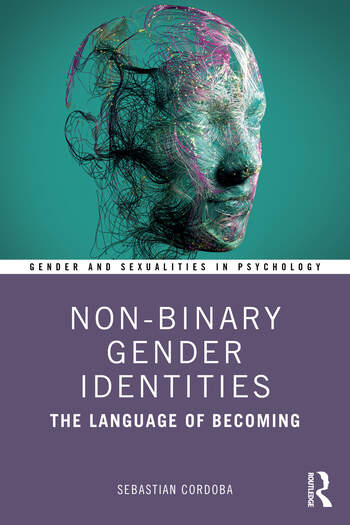
Dr Sebastian Cordoba (he/him) is a Senior Lecturer in Psychology at London Metropolitan University in the UK. Sebastian is a social and LGBTQ+ psychologist. His research interests include gender, sexuality, and language; new materialist approaches to research; and corpus linguistics. He is also a member of the Global Diversities and Inequalities Research Centre. His latest book “Non-binary gender identities: The language of becoming” (2023) published by Routledge, examines how non-binary people discover, adopt, and negotiate language in a variety of social settings, both offline and online.

Featured

New Publication: “Examining the Role of Childhood Experiences in Gender Identity and Expression: An Interpretative Phenomenological Analysis Using Social Learning Theory”

Dodgers, S., Cordoba, S., & Coe, J. (2023). Examining the role of childhood experiences in gender identity and expression: An interpretative phenomenological analysis using social learning theory. Gender Issues. https://doi.org/10.1007/s12147-023-09314-4

Steph DodgersSebastian Cordoba & Jennifer Coe

Abstract

This qualitative study examines the role of childhood experiences and memories in shaping individuals’ gender identities, expressions, and life trajectories. Whilst some research has examined the role of gender stereotypes in people’s life trajectories, no research has focused on people’s retrospective accounts of their gender socialisation about their current understanding of (their own) gender. We conducted eight semi-structured interviews with 20–30-year-olds living in the UK to do this. We employed interpretative phenomenological analysis to analyse our data, which enabled us to investigate participants’ memories of their gender socialisations, observations, and internalisations in childhood and their interpretation of these experiences. Using insights from social learning theory, this study provides further insights into the processes of observations, internalisations, and subsequent challenges to gender based on their retrospective accounts. We show the impact of hegemonic gender stereotypes in the participants’ life trajectories and hobbies (mainly sports), showing the limitations created by the gender binary system. Notably, the present findings support social learning theory, as it shows how the internalisation of gender can be challenged by new forms of gender resocialisation, including the promotion of gender equity in sports, the possibilities of gender expressions and identities beyond the binary, and the free articulation and expression of these concerns in society. By showing how gender internalisations can be malleable, this research provides practical recommendations for tackling unnecessary gender divisions in childhood settings.

Featured

Non-binary gender identities: The language of becoming (Cordoba, 2022) – A book review by Wally MBASSI ELONG, PhD.

Photo by Mikołaj on Unsplash

Dr Wally Shannon MBASSI ELONG, Associate Lecturer in Media, Communication and Cultural Studies, London Metropolitan University

Non-Binary constitutes an umbrella term designating gender identities that do not (neatly) fit into the binary gender norm (man/woman). Non-binaries (NBs) can adopt different personal pronouns to refer to themselves, alter their given names, embrace a different gender expression that what their sex assigned at birth may suggest they adopt – or mix multiple ways of expressing their non-binarity. They can also, if they wish, add a medical transition to that social one. Sebastian Cordoba’s Non-Binary Gender Identities (2022) addresses the lack of recognition of and research on non-binary individuals across the (Western) world, particularly in the United Kingdom. Cordoba acknowledges that “gender from a binary perspective has been discussed ad nauseum” (p.92) first by pathologizing ‘transness’, secondly by positioning the gender/sex binary as being an unquestionable core element of the self (from a positivist standpoint), and thirdly by arguing that genders (as well as sex and sexuality) are socially constructed. However, according to Cordoba, the latter perspective (social constructionism) also creates binary tensions and operations thereby assuming that “the gender binary is the hegemonic force that allows people to move between masculinity and femininity” (p.92). Thus, Cordoba goes beyond both positivism and social constructionism and examines the linguistic as well as the material settings from which non-binary identities emerge.

Building on Deleuze and Guattari’s (1987) assemblage theory – which argues that identity is not about what the self ‘is’ but about what they can ‘become’ or about how they assemble in fluid, exchangeable, and multiple ways – Non-Binary Gender Identities provides an understanding of “the different affects that contribute to the assemblages and the processes of becoming non-binary both online and offline” (p.94). Cordoba argues that non-binary gender identities assemble and produce various intensities that are neither essential nor entirely socially constructed. He develops the concept of ‘linguistic becoming’ to suggest that language constitutes a key affective intensity enabling NBs to become. He nonetheless insists that these linguistic becomings go together with material affective intensities such as bodies and social groupings which are part of the “multiple iterations of non-binary becomings” (p.259).

Non-Binary Gender Identities constitutes the fifth book of the Gender and Sexualities in Psychology book series edited by Elizabeth Peel and Elizabeth Stokoe. The series is an interdisciplinary one which covers areas such as gender, feminism, sexualities, and LGBTQ+ psychology. Sebastian Cordoba is himself a social and LGBTQ+ psychologist interested in research on how gender and sexual minorities apprehend and perform their identities in society. He clearly has expertise within the LGBTQ+ subject area which is in fact his niche. He uses innovative and mixed methods which fully correspond to the book series Non-Binary Gender Identities is part of.

In fact, to thoroughly capture and report on the (de/re) territorialisation of non-binary gender identities in offline and online settings within this book, Cordoba analysed and interpreted interviews, short writings, and a Non-Binary Corpus (NBC). He interviewed 22 NBs either face-to-face or online (through video conference) and questions revolved around non-binary discursive and linguistic usage, identity, and any discriminations they may have faced or are facing in their daily lives as NBs. Before these 22 non-binary-identified individuals’ interview, Cordoba asked them to write a 500 to 1000 words story about themselves. He encouraged them to use their preferred third person pronouns within a few sentences of their texts to index how they wanted people to refer to them. This short writing exercise was mostly unstructured which enabled participants to talk about any topic without being influenced by Cordoba. Finally, an anonymised non-binary online forum was turned into an NBC which was analysed using corpus linguistic tools. The latter generated a quantitative network of non-binary language that Cordoba then analysed qualitatively. The key factors impacting the territorialisation of the participants non-binary gender identities were linked to their assigned gender at birth, their exploration and discovery of the linguistic features that best index their relationship with their genders, their adoption of these features, and their embodiment. Several elements would allow (or otherwise) NBs to be safely out such as their class, education, race, and presentation.  Misgendering was highlighted as one of the main sources of distress for the participants especially when it came from friends, immediate family members, and LGBTQ+ groups.

The crucial strength of this book is its methodological design which I found quite innovative. It was interesting to read a book tapping into gender and queer studies merging both linguistic and material realities thereby effectively addressing the binary operations social constructionism often claims to address. My only concern (which Cordoba himself highlighted as a limitation of his research) is the lack of diversity (class, race, education) of those who were involved in the interviews and short writings. Overall, it is nonetheless and important book which contribution and findings are relevant to academia (gender and queer studies, social psychology, linguistics, cultural studies, etc.), policy makers, and (LGBTQ+) communities.

References

Cordoba, S. (2022). Non-Binary Gender Identities: The Language of Becoming. London and New York: Taylor & Francis. Kindle edition.

Deleuze, G. & Guattari, F. (1987). A thousand plateaus: Capitalism and schizophrenia (B. Massumi, Trans.). London: Continuum.

Featured

Books that shaped me…

Original link: The Psychologist – The British Psychological Society

Dr Sebastian Cordoba (he/him) told us about the books that informed, inspired and delighted him.

31 January 2023

The first book I loved…

One Hundred Years of Solitude by Gabriel García Márquez. As a child growing up in Colombia, it was impossible to escape the magical – and often political – world of Macondo, an isolated, fictional city that represents the struggles and hopes of Latin American people. I read this book several times as a child, charting the multi-generational family tree of the Buendías, and attempting to understand the use of magical realism to tell complicated stories relating to colonialism, war, and generational trauma. Writing this is making me want to read it again, as I’m sure my lens will be very different now! 

Favourite book now…

I find All About Love by bell hooks quite comforting. I love her writing style, her honesty, and her way of connecting personal stories with high level concepts relating to the philosophy and psychology of love, community, and affection. I read it during one of the most difficult times of the pandemic, when things felt hopeless. I have returned to this book during happy times as well. It taught me that love is not just a noun, but a verb – and that ‘to love’ is one of the most powerful tools to build meaningful connections and to a happier, more accepting society. 

The key ingredients of a good book…

I love when books strike an emotional chord while simultaneously teaching a valuable lesson. I have devoured the Heartstopper graphic novels (Volumes 1-4) by Alice Oseman. These books have all the things I need: beautiful illustrations, queer representation, emotional rollercoasters, life lessons, and the promise of more books!  

The role of books in our psychological growth…

Books allow us to grow our imaginations and to perceive the world in ways that challenge our preconceived notions. For me, it’s always felt great to feel represented. I consumed every single book I could that included queer characters or was written by queer people. This representation allowed me to come to terms with my own sexual and gender identities, providing me with a great deal of self-esteem and self-acceptance. Anything by Alison Bechdel (Fun Home), Kate Bornstein (Gender Outlaw), Leslie Feinberg (Stone Butch Blues), Virginia Woolf (Orlando), and James Baldwin (Giovanni’s Room) made me feel at home. It’s disheartening to hear that books on LGBTQ+ issues are being banned in places like Texas, as this will only limit people’s understanding of themselves and others, leading to stigma, discrimination, and internalised homophobia/transphobia. 

A book which changed the way I think

Judith Butler’s Gender Trouble changed the way I understood gender and sex. Butler’s key argument is that these concepts are socially constructed and in constant motion, as they are affected by culture, history, class, sexuality etc. This book allowed me to see that sex is as multi-dimensional and complex as gender is, and that reducing it to a binary is reductive and, in many ways, irresponsible. The labels that we attach to our bodies/identities are contingent upon our culture, which is constantly changing. 

One book that all psychologists should read…

Queer: A Graphic History by Meg-John Barker is a must-read for any psychologist looking to understand what queer is all about. It’s illustrated by cartoonist Jules Scheele, making it not only an accessible read, but an entertaining one. I have recommended it to students, colleagues, friends, and family members, and I still read it from time to time when I want to revisit a key concept in queer theory. 

A ‘desert island’ book…

Hopscotch by Julio Cortázar has been on my reading list for – and I hate to admit it – decades. It’s long, complex, and it can be read in different ways, allowing for multiple endings. I’ve always wanted to read it, so I would probably have the time to do so in a deserted island. I would most likely read it several times, following all the variations. 

A book I find therapeutic to read…

Last Christmas, my husband gifted me No Straight Lines, an anthology of queer comics covering a 40-year period from the late 1960s to the late 2000s. I read the whole thing over the break, and I found it extremely therapeutic – it was entertaining, enlightening, funny and inspiring. 

Bookshelves should be: in alphabetical order/free range

Alphabetical! How would you find the book otherwise? There is aesthetic value in organising by colour or height, but it is less practical when your home library grows. 

Last pages: sneak a peek or never look?

I peek, but only to the last sentence. There’s something poetic about knowing something about the ending, even if the context is missing. 

Sebastian Cordoba is a senior lecturer in social psychology at London Metropolitan University. His book Non-binary gender identities: The language of becoming is published by Routledge. It examines how non-binary people discover, adopt, and negotiate language in a variety of social settings, both offline and online. It considers how language (including gender-neutral pronouns, names and labels) is a central aspect of identity and the subject of much debate in recent years.

Featured

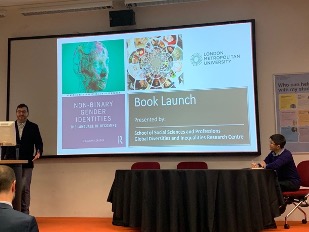
Book launch: ‘Non-binary Gender Identities: The Language of Becoming’

London Metropolitan University – Past Events – Original Post

On 12 December 2022, the School of Social Sciences and Social Professions and Global Diversities and Inequalities Research Centre at London Metropolitan University hosted a hybrid event celebrating the launch of Dr Sebastian Cordoba’s most recent book, Non-binary Gender Identities, which was published in October 2022 by Routledge.

Dr Sebastian Cordoba (he/him) is a Senior Lecturer in Psychology at London Metropolitan University in the UK. Sebastian is a social and LGBTQ+ psychologist. His research interests include gender, sexuality, and language; new materialist approaches to research; and corpus linguistics. He is also a member of the Global Diversities and Inequalities Research Centre.

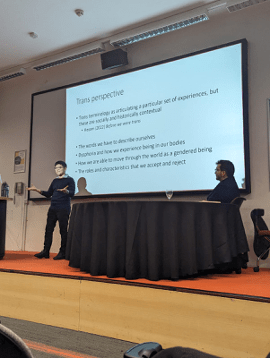
The launch featured a presentation on the book’s key themes by Sebastian, followed by guest speakers Dr Zowie Davy (she/her, Associate Professor at the Centre for LGBTQ Research, De Montfort University, UK) and Dr Kat Gupta (they/them, Honorary Fellow at the University of Roehampton in London, UK). This event was chaired by Dr Lakis Zervoulis (he/him, Senior Lecturer in Social Psychology, London Metropolitan University, UK).

Non-Binary Gender Identities examines how non-binary people discover, adopt, and negotiate language in a variety of social settings, both offline and online. It considers how language, in the form of gender-neutral pronouns, names, and labels, is a central aspect of identity for many and has been the subject of much debate in recent years. This book is part of Routledge’s Gender and Sexualities in Psychology book series, which showcases scholarly work over a wide range of areas within gender and sexualities in psychology, and the intersection of gender, feminism, sexualities and LGBTIQ psychology with other areas of the discipline.

During the event, Sebastian addressed his positionality as a trans-affirming, queer researcher; what led him to study non-binary people’s language and identity; as well as the need to create spaces (such as this event) where trans and non-binary identities – and their mere existence – are not the subject of debate and their existence as women, men, and non-binary people are affirmed. Sebastian argued for the urgent need to examine the plurality of lived experience, including the need to understand both language and gender as complex processes, possibilities, and as becoming rather than being.

Sebastian then outlined the aims of his research, which examined the psychological, social, and linguistic experiences of non-binary people. He illustrated the multiple, complex, and evolving ways in which non-binary people use language to express their gender identities, bodies, authenticity, and navigate social interactions – especially those where their identities are not affirmed. He provided a number of key findings which shed light on the gender and linguistic becomings of non-binary people, a pioneering theoretical framework developed in the book, which reflects the dynamic realities of language, subjectivities, and the materiality of the body. His research also demonstrates the negative impacts of language-based discrimination on non-binary people. Lastly, Sebastian discussed the methodological and theoretical applications of his research, as well as the vital need to continue providing more representation of non-binary people’s material and linguistic experiences, particularly within the field of psychology.

Dr Zowie Davy and Dr Kat Gupta provided support for Sebastian’s important research and its theoretical and methodological applications and possibilities. Assemblage theory, which Sebastian employs in his research, was a central theme in their talks, as this approach proved to be a useful avenue to investigate the “the myriad ways in which gender identities are not only socially constructed, but how these identities are maintained, performed, indexed, and interpreted by others” (Cordoba, 2022, pp. 37).

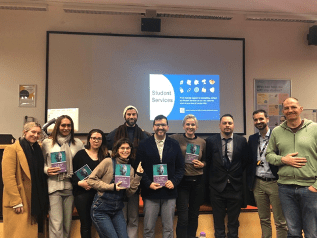
The event concluded with short, but powerful Q&A session, where in-person and online attendees asked questions relating to the book’s limitations, applications, and potential impact. There were questions about the power of gender-neutral language and its potential (ideal) direction(s), which were addressed by the speakers. All in-person attended enjoyed drinks and canapes provided by the School of Social Sciences and Professions, and Sebastian signed copies of his books and took pictures with guests, which included students, staff, and representatives from external organisations such as the Home Office.

The copy of book can be purchased via Routledge.

Featured

‘Non-Binary Gender Identities: The Language of Becoming’, OUT NOW

20% Discount Available – enter the code FLA22 at checkout

Hb: 978-0-367-63710-1 | $128.00 | £96.00

Pb: 978-0-367-63709-5 | $35.96 | £27.99

ABSTRACT

Non-Binary Gender Identities examines how non-binary people discover, adopt, and negotiate language in a variety of social settings, both offline and online. It considers how language, in the form of gender-neutral pronouns, names, and labels, is a central aspect of identity for many and has been the subject of much debate in recent years.

Cordoba captures the psychological, social, and linguistic experiences of non-binary people by illustrating the multiple, complex, and evolving ways in which non-binary people use language to express their gender identities, bodies, authenticity, and navigate social interactions – especially those where their identities are not affirmed. These findings shed light on the gender and linguistic becomings of non-binary people, a pioneering theoretical framework developed in the book, which reflects the dynamic realities of language, subjectivities, and the materiality of the body. Informed by these findings, the text offers recommendations for policy makers and practitioners, designed to facilitate gender-related communication and decrease language-related distress on non-binary people, as well as the general population.

This important book advances our understanding of non-binary gender identities by employing innovative methodologies – including corpus-based research and network visualisation – furthering and developing theory, and yielding original insights. It is essential reading for students and academics in social psychology and gender studies, as well as anyone interested in furthering their understanding of non-binary gender identities.

TABLE OF CONTENTS

Chapter 1 – Becoming non-binary: Language and identity

Chapter 2 – Gender and linguistic becomings: Beyond positivism and social constructionism

Chapter 3 – Materialist methods: The research-assemblage

Chapter 4 – Gender and linguistic becomings: Affective intensities

Chapter 5 – Language-related distress: Proximities and intentions

Chapter 6 – The non-binary corpus: A network of linguistic and material intensities

Chapter 7 – Non-binary assemblage: Becoming something else

To order a review copy, please complete a Request a Book form

Featured

New Book, Available for Purchase on September 21, 2022

Non-Binary Gender Identities: The Language of Becoming

Routledge’s Gender and Sexualities in Psychology

Non-Binary Gender Identities examines how non-binary people discover, adopt, and negotiate language in a variety of social settings, both offline and online. It considers how language, in the form of gender-neutral pronouns, names, and labels, is a central aspect of identity for many and has been the subject of much debate in recent years.

Cordoba captures the psychological, social and linguistic experiences of non-binary people by illustrating the multiple, complex, and evolving ways in which non-binary people use language to express their gender identities, bodies, authenticity, and navigate social interactions – especially those where their identities are not affirmed. These findings shed light on the gender and linguistic becomings of non-binary people, a pioneering theoretical framework developed in the book which reflects the dynamic realities of language, subjectivities, and the materiality of the body. Informed by these findings, the text offers recommendations for policy makers and practitioners, designed to facilitate gender-related communication and decrease language-related distress on non-binary people, as well as the general population.

This important book advances our understanding of non-binary gender identities by employing innovative methodologies – including corpus-based research and network visualisation – furthering and developing theory, and yielding original insights. It is essential reading for students and academics in social psychology and gender studies, as well as anyone interested in furthering their understanding of non-binary gender identities.

Table of Contents

1. Becoming Non-binary: Language and Identity 

2. Gender and Linguistic Becomings: Beyond Positivism and Social Constructionism 

3. Materialist Methods: The Research-assemblage 

4. Gender and Linguistic Becomings: Affective Intensities 

5. Language-related Distress: Proximities and Intentions 

6. The Non-binary Corpus: A Network of Linguistic and Material Intensities 

7. Non-binary Assemblage: Becoming Something Else

Reviews

‘This book is a vital addition to the burgeoning research literature on non-binary experience, and to gender studies more broadly. It presents the first study of its kind to examine the language that non-binary people use to make sense of their experience. Beautifully written, accessible, and engaging, this book invites the reader into exciting and innovative theories and methods, as well as some truly fascinating findings.’

Dr Meg-John Barkerauthor of Life isn’t Binary

‘This important text persuasively argues for scholarship to understand how trans and non-binary linguistics centres practices and subjectivities, important to any understanding of gender. They cast new light on gender and the power of words, the ephemeral nature of categories, and their significance to embodiment.’

Dr Zowie DavyDe Montfort University, UK

About the Series

Gender and Sexualities in Psychology is a book series showcasing scholarly work over a wide range of areas within gender and sexualities in psychology, and the intersection of gender, feminism, sexualities and LGBTIQ psychology with other areas of the discipline.The series includes theoretically and empirically informed scholarship including critical, feminist, queer, trans, social, and intersectional perspectives, and encourages creative and innovative methodological approaches.  The series adopts an inclusive approach to the discipline of psychology (as well as its cross-cutting relationship to related disciplines) and a recognition of the diversity in research on genders and sexualities.

Featured

Queering the Curriculum Seminar Series

To celebrate Pride Month, the University of Suffolk hosted a seminar series entitled Queering the Curriculum. You can watch all talks here: https://queeringthecurriculum.wordpress.com/

The virtual event, which ran for three days from Thursday 24 – Saturday 26 June, was hosted by the University’s LGBTQ+ Staff Network and the Gender and Sexuality Research Interest Group — which I lead.

This event brought together a number of academics, educators, students, activists, practitioners, and diversity trainers to discuss what Queering the Curriculum means in 2021.  

I talked to BBC Radio Suffolk about this event. The interview is available on BBC Sounds (Scroll to 33.51)

There is a need to recognise gender and sexual diversity in our educational practices. Many LGBTQ+ students do not feel represented in the teaching material – from pronouns, to the use of man as norm like chairman, policeman, etc., to assumptions about people’s genders and sexualities, – which can make them feel disregarded and excluded. This event aims to illustrate how – and why – the teaching curriculum should adapt to account for our students’ diverse identities and experiences, thus helping us promote a more welcoming and respectful teaching environment for all.

queering the curriculum 0
Featured

CSULB Alumni Award

Each year, the Department of Human Development at CSULB, where I completed my undergraduate studies, recognises an outstanding alumni who has demonstrated success in their chosen profession.

This year, I had the honour and the privilege of receiving this award via Zoom. This event was live-streamed via Facebook Live.

Here’s the short bio they read:

Originally from Colombia, Dr Sebastian Cordoba graduated from CSULB with a BA in Human Development in 2011. After spending two years in South Korea and Japan where he taught English as a second language, he completed an MA in General Psychology at The City College of New York. In 2016, Dr Cordoba moved to the UK to pursue a PhD in Psychology from De Montfort University, which he recently completed (March 2020). Dr Cordoba is an adjunct lecturer at The City College of New York where he has taught Psychology of Gender and Sexuality, Adolescence and Youth, Lifespan Development, and Applied Statistics.

Featured

Disruption and the “New Normal”: A Queer Perspective

Disrupted: Wedding Invitation – Valencia, Spain – Summer 2020 – Drawing by @milomars_

It’s been three weeks since I defended my PhD dissertation (which is insane!), and over five weeks since I started practicing social distancing. It was difficult to figure out these dates, as I have no sense of time or space anymore. Covid-19 has changed my life – our lives – dramatically, disrupting normalcy and creating a “new normal” for us all. Adapting to these changes is difficult, but not impossible. And I believe that queer (LGBTQ+) people are a clear testament of the human capacity to adapt, re-emerge, and re-conceptualise the idea of “normal.”

I first read about coronavirus in January, when multiple stories about it were emerging, and reports (and videos!) of people dying were circulating on Twitter. Admittedly, I became obsessed with it, checking the statistics and the latest reports on the virus multiple times a day. It became clear to me that this coronavirus was dangerous, and I began to have panic attacks about the possibility of it affecting all of us – our families, finances, economies, food security, etc. I was also scared I was going to get sick before one of the most important days of my life (my viva), so I quarantined weeks before it was official in the UK. I didn’t get sick (though I’m still scared). But several of my friends in New York and London did. They’re all okay, luckily, as they’re young and generally very healthy people. But the possibility that one of my family members, close friends, or colleagues will eventually get it is terrifying.

I began to feel frustrated, angry, depressed, and hopeless as I saw governments’ (lack of) response to the imminent pandemic. I was – and still am – grieving. I started posting any type of useful – and verified – information I found on social media, and I called my family almost daily to share information about hand-washing, how to use masks correctly, flattening the curve, easy recipes, “getting ready,” etc. I did all this, I think, to re-gain a sense of control over this situation.

Life has changed for me – and for everyone – in many ways. And I’m learning to let go of control – to go with the flow and to queer this situation. All of my plans and some of my aspirations for this year have been postponed or put on hold. I was meant to get married to my partner this summer in Spain. I not only wanted to marry the love of my life this summer, but I also wanted to see – in person – most of my closest friends and family members at the wedding. We were also planning to go to Korea and Japan for our honeymoon, as we met in Korea and we spent – and lived together for – the first five months of our relationship in Japan. I also aspired to get a job in academia this year but, as of today, I have received three rejection letters stating that they are no longer hiring because of Covid-19. It is now clear to me that this might not happen this year, unless I experience an extraordinary stroke of luck. My 2020 vision is not going according to plan and I’m losing control. But this is not the first time. As a queer person, I have felt this before – the feeling that things are not normal, the sense of isolation and rejection, and the sense of hopelessness that can only be “cured” by reimagining the possibilities of desire, intimacy, disruption, and acceptance – by losing and regaining control.  

Over the last month I have learned many lessons – I think we all have. But I have been thinking about the concept of disruption and how it parallels with queer existence. I learned that humans are delicate. Our mere existence, as we know it, is governed by a multitude of abstract and material elements: money, mobility, intimacy, electricity, desires, satisfaction (psychological and physical), hormones, fluids, consumption, freedom, etc. However, when one of these concepts gets severely disrupted, it has the capacity to create a domino effect which can also severely disrupt some of the other elements. When this occurs, it is normal to feel despair, hopelessness, and confusion. Our mere existence shatters; our sense of purpose extinguishes; and our emotions become intricate and volatile.

Humans are highly adaptable beings, however. We have the capacity to reconceptualise, reimagine, recreate, renew, and reorganise. Brain plasticity is real, but these neurological pathways do not emerge overnight. Societies do not rebuild themselves in a matter of days either. And when they do, they never resemble the old – so the new landscape becomes the “new normal.” We are full of productive capacities, and the way that we have, as a society, coped with the pandemic – while imperfect – is a testament of our ability to reimagine of possibilities. We are reimagining work, exercise, sex, kinship, goals, economies, fluids, air, transport, language, fashion, politics, etc.

Queer people have been doing this for millennia: reimagining these abstract and material elements and creating new spaces where our existence is possible. Due to our various gender and sexual identities, expressions, desires, and practices, many of us have been isolated from our families, churches, occupations, and public spaces for a long time. This has meant that we are more likely to be unemployed, to use drugs, to have anxiety and depression, and to be victims of hate crime. However, home with our chosen families (roommates, partners, pets, queerspawn, etc.) or alone are safe havens for us – they always have been. The streets have rarely been safe for us, and they continue to be unsafe. Despite these disruptions, this sense of alienation and victimisation has allowed us to create new spaces, desires, power dynamics, bodies, communities, systems, linguistic codes, theories, aesthetics, complexities, pride, resistance, action, etc. that we can call our own. Queer people have recreated and reimagined these possibilities, drawing from our anguish, our gayness, our desire to feel. We are accustomed to disruption. Our mere existence has disrupted – and continues to disrupt – normalcy and unmarked normativities. Now, amid a pandemic, it’s our time to continue reimagining these possibilities – to let go of control and to queer our existence.

Forthcoming Publication in ‘Qualitative Research in Psychology’

Strunel, A.M., & Cordoba, S. (forthcoming). Insider/outsider dynamics: A reflexive thematic analysis of reflexivity/positionality in the ‘Qualitative Research in Psychology’ journal. Qualitative Research in Psychology.

Abstract

This study examines the concept of reflexivity/positionality using secondary data, specifically all articles published in the ‘Qualitative Research in Psychology’ journal up to and including 2023. A Reflexive Thematic Analysis was conducted on all reflexivity/positionality statements to investigate how they were used in the journal, how researchers articulate their positionality and manage the complexities of social identities within the research process, and the dynamics between researchers and participants. Three main themes were developed: (a) background reflexivity, utilising previous literature; (b) self-identification, detailing the researchers’ identities; and (c) navigating insider-outsider dynamics, elaborating on their relationship with participants. These findings show the varied ways researchers express reflexivity in published work and point to a growing tendency to integrate reflexivity as part of methodological practice. We argue that by engaging in these practices, researchers can foster a more nuanced and dynamic understanding of reflexivity in qualitative research, thereby enhancing the credibility and depth of their analyses.

Keywords: positionality, reflexivity, reflexive thematic analysis, qualitative research